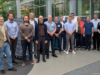
Key takeaways from Aachen Hydrogen Colloquium 2026
The discussions at the 5th Aachen Hydrogen Colloquium 2026 highlighted a clear shift in the hydrogen industry.
Hydrogen is no longer primarily a vision for the future. Across electrolysis, Power-to-X, infrastructure, and industrial applications, the conversation is increasingly focused on implementation, scalability, and economic viability.
While technology development remains important, the critical challenge has become execution.
The question is no longer whether hydrogen can contribute to the energy transition. The question is how organizations can deploy projects faster, more efficiently, and at industrial scale.

Europe has the fundamentals
One of the strongest messages from this year’s event was that Europe already possesses many of the ingredients required for a successful hydrogen economy.
Participants highlighted the region’s strengths in:
- Engineering expertise
- Industrial know-how
- Research capabilities
- Technology development
- Regulatory frameworks
At the same time, speakers repeatedly stressed that technical leadership alone will not guarantee success.
As projects move into deployment, greater agility, faster decision-making, and new business models will be needed to accelerate commercialization.
Industrialization has become the bottleneck
Across multiple presentations and discussions, industrialization emerged as a recurring theme.
Many technologies are reaching commercial maturity. The challenge now is scaling them efficiently.
Success will increasingly depend on how organizations combine:
- Standardization
- Project-specific engineering
- Supply-chain resilience
- Manufacturing scalability
- System integration
The industry is entering a phase where execution capabilities may matter just as much as technological innovation.

Electrolyzers are becoming energy-system assets
Another important insight concerned the evolving role of electrolyzers.
Historically, discussions focused primarily on hydrogen production efficiency and system costs. Increasingly, however, electrolyzers are being viewed as active elements within broader energy systems.
This creates new requirements related to:
- Dynamic operation
- Grid integration
- Grid code compliance
- Flexible load management
- Reliable performance in volatile power systems
As renewable generation expands, these capabilities are becoming core design requirements rather than additional features.

From feasibility to reality
These topics were reflected in the joint presentation by FEV and Chiyoda Corporation:
From Feasibility to Reality: Chiyoda and FEV’s Joint Pathway to Sustainable Hydrogen Carriers
The presentation explored how early alignment of feasibility studies, regulatory requirements, certification pathways, and engineering design can help create execution-ready projects.
The central message closely mirrored the broader discussions at the conference: successful hydrogen deployment requires a holistic approach that integrates technology, economics, regulation, and implementation planning from the outset.
Looking ahead
The hydrogen industry is entering a new phase of maturity. The foundations have largely been established. Technology continues to advance. Industrial demand is growing.
The next challenge is industrial execution.
Organizations that successfully combine technical expertise with scalable project delivery capabilities will be best positioned to translate hydrogen ambitions into real-world impact.
The discussions in Aachen demonstrated that the future of hydrogen will not be defined by vision alone. It will be defined by the ability to industrialize, scale, and execute.
In connection:From Feasibility to Reality : Chiyoda and FEV’s
Joint Pathway to Sustainable Hydrogen
CarriersFrom feasibility to reality: Chiyoda and FEV’s joint pathway to sustainable hydrogen carriersFrom feasibility to reality: Let’s talk about sustainable hydrogen carriers
:

Kyra Johnen-Thier
Solution Leader Municipal Ecosystems
FEV Consulting
Connect with Kyra via LinkedIn or use our contact form!
Ähnliche Beiträge
FEV ranks first in Germany’s GreenTech-Award 2026
FEV has achieved first place in the GreenTech-Award 2026, conducted by the Deutsche Gesellschaft für Verbraucherstudien (DtGV). With a score of 83.94, FEV received the highest score among 232 award-winning companies. The ranking is based on independent patent analysis. Companies…
Project HollowEL started: Advancing next-gen bubble-free PEM electrolysis towards industrial application
Green hydrogen production relies on electrolysis technologies that combine high efficiency, durability, scalability, and cost-effective manufacturing. However, conventional electrolyzer cells still suffer from performance losses caused by gas bubble formation at the electrode surfaces, which impairs mass transport and increases…
FEV strengthens cooperation with AHK North China to advance new energy and decarbonization initiatives
Building stronger connections between Europe and China’s energy ecosystems The transition towards sustainable energy systems requires more than technological innovation. It also depends on strong international partnerships that connect companies, institutions, and expertise across regions. Against this backdrop, representatives from…