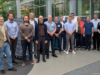
Key takeaways from World Hydrogen Summit 2026 in Rotterdam
Three days, one clear message: The hydrogen industry is ready for execution
The World Hydrogen Summit & Exhibition 2026 in Rotterdam once again demonstrated why the event remains one of the most important meeting points for the global hydrogen community.
Over three days, industry leaders, technology providers, project developers, investors, and policymakers came together to discuss the future of hydrogen and its role in industrial decarbonization.
For the FEV energy + resources team, one message stood out throughout countless conversations, presentations, and panel discussions:
The hydrogen industry is maturing, and the focus is shifting from ambition to execution.
While only a few years ago discussions centered on technology readiness and market potential, today’s conversations increasingly revolve around project implementation, investment certainty, and industrial deployment.

Hydrogen’s role remains strong
Despite ongoing market challenges, the overall mood at the summit was cautiously optimistic.
Hydrogen continues to be viewed as a critical building block for energy transition and industrial defossilization, particularly in sectors where direct electrification remains difficult.
The question is no longer whether hydrogen has a role to play.
Instead, stakeholders are asking how projects can be implemented at scale and with sufficient commercial viability.
FEV at the World Hydrogen Summit
At the event, Marc Oliver Gomperts and Dr. Thorsten Schnorbus presented:
“From hydrogen ambition to industrial impact: FEV’s solutions for hard-to-abate energy transition”
and participated in the panel discussion:
“The Art of Successful Project Development and Execution”
during the International Power-to-X Workshop organized by Fraunhofer ISE and TNO.
Throughout the exhibition, visitors also engaged with FEV experts to discuss engineering solutions across the hydrogen value chain, including:
- Fuel cell technologies
- Electrolyzer systems
- Battery systems
- Carbon capture solutions
- eFuel production
- Industrialization approaches for large-scale deployment

Three key takeaways from Rotterdam
1) Resilience is becoming as important as sustainability
One of the strongest themes throughout the event was the growing importance of resilience.
Alongside climate objectives, organizations increasingly view hydrogen as a way to strengthen:
- Energy security
- Supply diversification
- Industrial competitiveness
- Regional value creation
- Strategic independence
This shift broadens the business case for hydrogen and reflects changing geopolitical and economic realities.
2) Regulation has become the main bottleneck
A recurring observation across numerous discussions was that technology is often no longer the primary obstacle.
Many projects have reached a level of technical maturity that allows implementation.
Instead, project development is frequently slowed by:
- Complex regulatory frameworks
- Lengthy permitting procedures
- Uncertain investment conditions
- Lack of planning security
Addressing these challenges will be crucial for accelerating project deployment.
3) The industry mindset has changed
Perhaps the most notable takeaway was the shift in mindset.
The hydrogen sector is becoming increasingly implementation-focused.
Rather than discussing future possibilities, stakeholders are concentrating on:
- Delivering projects
- Creating bankable business cases
- Scaling industrial applications
- Managing deployment risks
In short: the market has moved from “Should we do hydrogen?” to “How do we execute successfully?”
Looking ahead
The discussions in Rotterdam confirmed that hydrogen remains a key pillar of the global energy transition.
At the same time, the industry is entering a new phase characterized by industrialization, execution, and commercialization.
For technology providers, project developers, investors, and policymakers, success will increasingly depend on the ability to transform hydrogen ambitions into real-world projects and tangible industrial impact.
Events such as the World Hydrogen Summit continue to provide a valuable platform for exchanging insights, identifying challenges, and shaping the next stage of market development.
In connection:Let’s connect and turn your hydrogen strategy into an industrial reality together!

Marco Dornauer
Head of Business Development
FEV energy+resources
Connect with Marco via LinkedIn or use our contact form!
Similar posts
FEV ranks first in Germany’s GreenTech-Award 2026
FEV has achieved first place in the GreenTech-Award 2026, conducted by the Deutsche Gesellschaft für Verbraucherstudien (DtGV). With a score of 83.94, FEV received the highest score among 232 award-winning companies. The ranking is based on independent patent analysis. Companies…
Project HollowEL started: Advancing next-gen bubble-free PEM electrolysis towards industrial application
Green hydrogen production relies on electrolysis technologies that combine high efficiency, durability, scalability, and cost-effective manufacturing. However, conventional electrolyzer cells still suffer from performance losses caused by gas bubble formation at the electrode surfaces, which impairs mass transport and increases…
FEV strengthens cooperation with AHK North China to advance new energy and decarbonization initiatives
Building stronger connections between Europe and China’s energy ecosystems The transition towards sustainable energy systems requires more than technological innovation. It also depends on strong international partnerships that connect companies, institutions, and expertise across regions. Against this backdrop, representatives from…